
A Correction

I am on a rage walk from Rose Avenue to downtown Blacksburg. The Huckleberry Trail smells like honeysuckle and walnut. The birds are louder than I have heard in some time. The sky glows hot like God spilled a cup of lava over the hills. And I have just learned that my uncle used Claude to write my Nana’s obituary.
Much of the anger in my body is surely the result of my own ego, the impulse to trust that I am the one who would know that Nana would have hated this. On a pettier level, it is difficult to compartmentalize this revelation from the fact that this is the same uncle who, upon learning that I had written a novel, said in a family group chat, “…I think I have a couple [novels] in me…”
In years past, I would have surely used this opportunity to ruin a family function or get blackout and fire off some incoherent text messages. I will refrain from that for now, not because I find the use of generative AI in this (especially this, good god man!) or any context defensible, but because my Nana’s soul is sturdier than that. She does not need my protecting.
But the thing about words after somebody dies is that they are not for the person who is dead. They’re for us, the living. This is not to say that the practice of remembrance is a futile endeavor. It’s how humans connect, keep going, make it all hurt a little less. There is great progress in death. When someone dies, and it hurts, it also means that you were born, that you are alive, that there is this great big web of humans that had to exist for thousands of years through wars, plagues, famines, and great migrations for you to exist. Better yet, the pain means that there are feelings in you, and that they are worth expressing.
So, I say all this now, knowing damn well that it is for me, knowing damn well that I am alive.
What I remember of my Nana is her heart, her mind, her smile, her hands, the way she’d pull a weed or waddle out to the porch with a pitcher of lemonade and a plate of BLT’s, that she was always the last person at the dinner table, that her favorite jokes were ones about white horses in mud, that she’d pluck a blacksnake off the pillars on the porch without hesitation and set it free in the pines with a smile, how she’d bust a U-turn on I-81 to get a better look at a red-tailed hawk, how she’d pull up a river rock and snatch a crawdad from behind with fingers like talons, the way she’d sneak up on Papa and yank out one of his leg hairs while he was sleeping, how she’d quell his rage with a stern face, that she figured humans were at their best when they were caring for one another and preserving that world which so graciously allowed them to exist, that home was everything, that it was “Big Rock Candy Mountain” before bed and NPR and Folgers in the morning, that the best way to solve anything was to sit and talk, that she always had a bag of apple slices on her, how she’d kneel in the bow of a canoe while she pointed out big rocks in the rapids, that she always wished we’d stay a little longer, that she’d stand in the driveway and wave until the car disappeared, that she was singing “Country Roads” ‘till she died.
Once, Nana and I were sitting on the porch, splitting a Coke, and she said, “There are things you know, and there are things you feel.” I smiled and nodded, pretending to know what it meant, pretending it meant anything. It felt like a nothing, one of those truisms whispered between ridges to pass an afternoon or fill a lull in conversation.
I understand it now.
See, right now, amongst these birds flying through the fire in the sky, what I know is that people all cope with grief differently. They go about the world in different ways, dealing with the fear and loss of it all the best they can with the tools they possess. I know that in my uncle’s mind, he saw Claude as a useful tool, an error-free way to produce a concise couple of paragraphs for some old lady in Charleston, West Virginia to read and say, “Aw, shucks. Did you see Linda died?”
Problem is, what I feel is angry, is irrational, is that remembrance is a quintessentially human practice, one which requires a soul to be effective, to serve any purpose, to buoy the love and joy in our hearts amongst this big wide sea of ache and loss and eternity. Likewise, in this moment, I feel that my uncle is a twerp. I also feel bad for him, that though he has a couple of novels in him, he does not have an obituary. So too, I feel that I love him deeply.
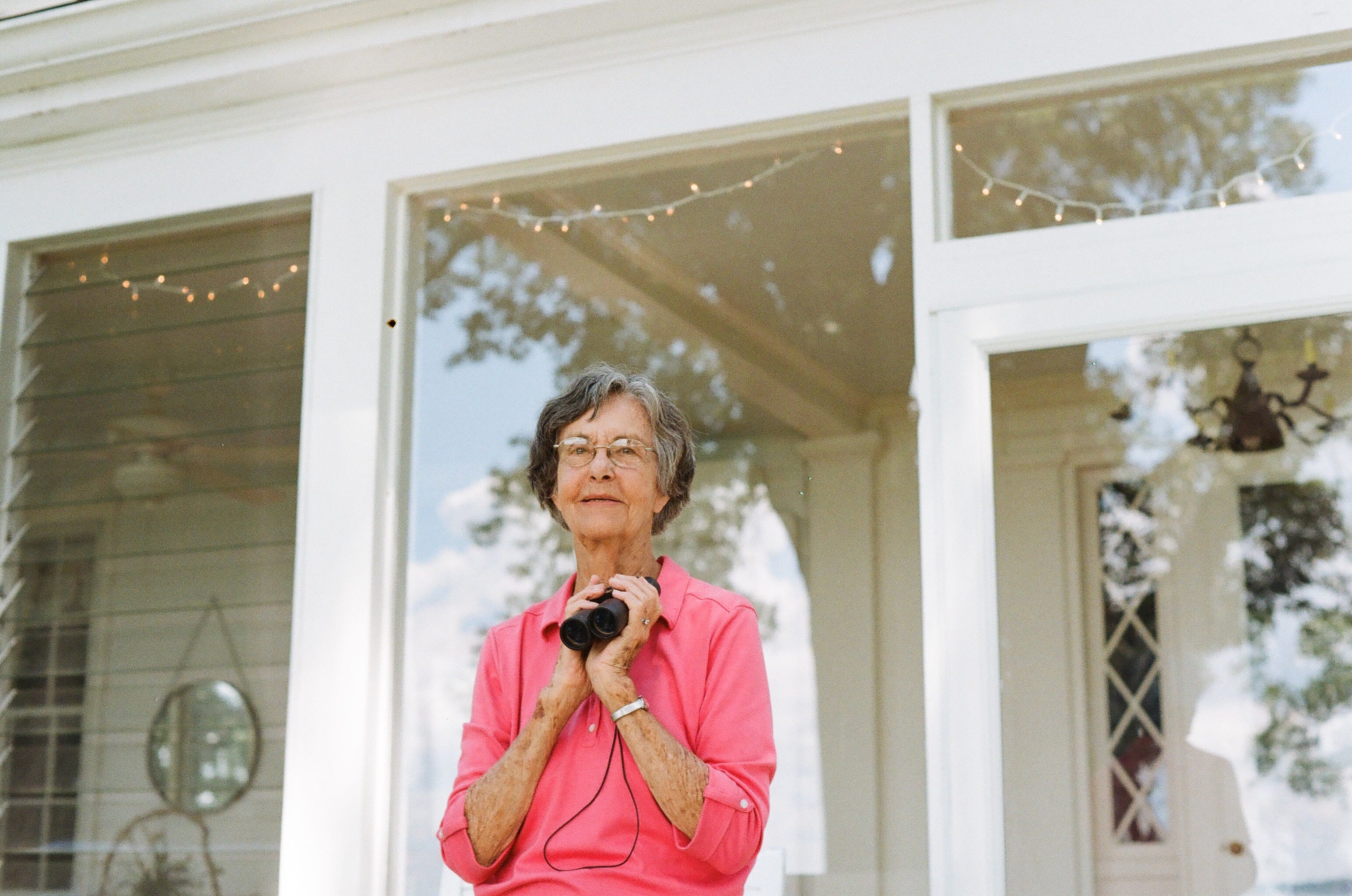
Anyhow, here is a picture I took some years ago of Linda. She is taking a break from watching the birds over the Rappahannock River, smiling at her family, basking in the warmth and chaos of all that humanity bouncing about that still and salty summer air. Claude is not there.
Hi, friends. I wrote a book called Dirt Pusher. It’s forthcoming from Hub City Press. You can pre-order it here.
That was a terrific post and tribute. It was also a fine example of what A.I. cannot do. Write with feeling. - Jim
You've done her proud. It always heartens me to see something so stirring and beautiful like this, something Claude couldn't get within a million miles of. I'm not always the best at commenting on every piece, but whenever I see one of yours pop up, I stop and click on it right away.